Born in an era where people with a disability were often mocked or ridiculed, Audley Brodbeck quickly rose above adversity to let his brilliant mind shine through.
Born at Barraba, on February 1, 1923, the eldest child of Bert Brodbeck and Connie Bradbury, Aud quickly adapted to life with just 10 per cent vision, making use of his sharp, inquiring mind, and hunger for knowledge, which led to his career as a radio engineer.
In 1924, the family moved to Gunnedah and settled on the Boggabri Road property May Park, where Bert Brodbeck worked as a farmhand. The small property was owned by Bill Wallace, the licensee of the Freemasons Hotel, which later became the ParkView.

When his father was given the green light by his employer to make extra money trapping rabbits and selling the skins, along with the hides of sheep that died on the place, the family finally had their own car – a Chev Tourer that cost 290 pounds. In 1928, the family moved in to Gunnedah so the children could attend school, living in a rented flat over the chemist shop owned by Matthew Hargraves and later occupied by Cyril Smithurst.
The following year, Aud’s parents purchased a guest house in Elgin Street, financed by the sale of their car. This proved to be a fortuitous move as it was the first year of the Great Depression, a time when thousands of people were scrambling for jobs and a place to live.
The guest house catered for permanent and casual guests and it was here that Aud was introduced to the world of entertainment. George Sorlie was one of these characters, an entertaining performer who set up his show on vacant land in Marquis Street and did imitations of Al Jolson and Paul Robeson, as well as entertainment in the form of dancing girls and musicians. The guest house also accommodated the Mack’s Variety Revue Company, that toured the show circuit in the 1930s – and many other young hopefuls like Buddy Williams, who got their start with Mack’s.
When Aud started school in 1929, he soon discovered that there was no place for children with disabilities in the mainstream schooling system. Because of his poor eyesight he was often treated with contempt and called lunatic – a word frequently used against kids with a handicap.
Often, he could not copy all the information down from the board and would have to walk right up to the blackboard for a closer look.
Despite his disability, Aud found a great friendship in his mate Malcolm Panton and with his intensely curious mind, the pair would investigate anything and everything that was electrical.
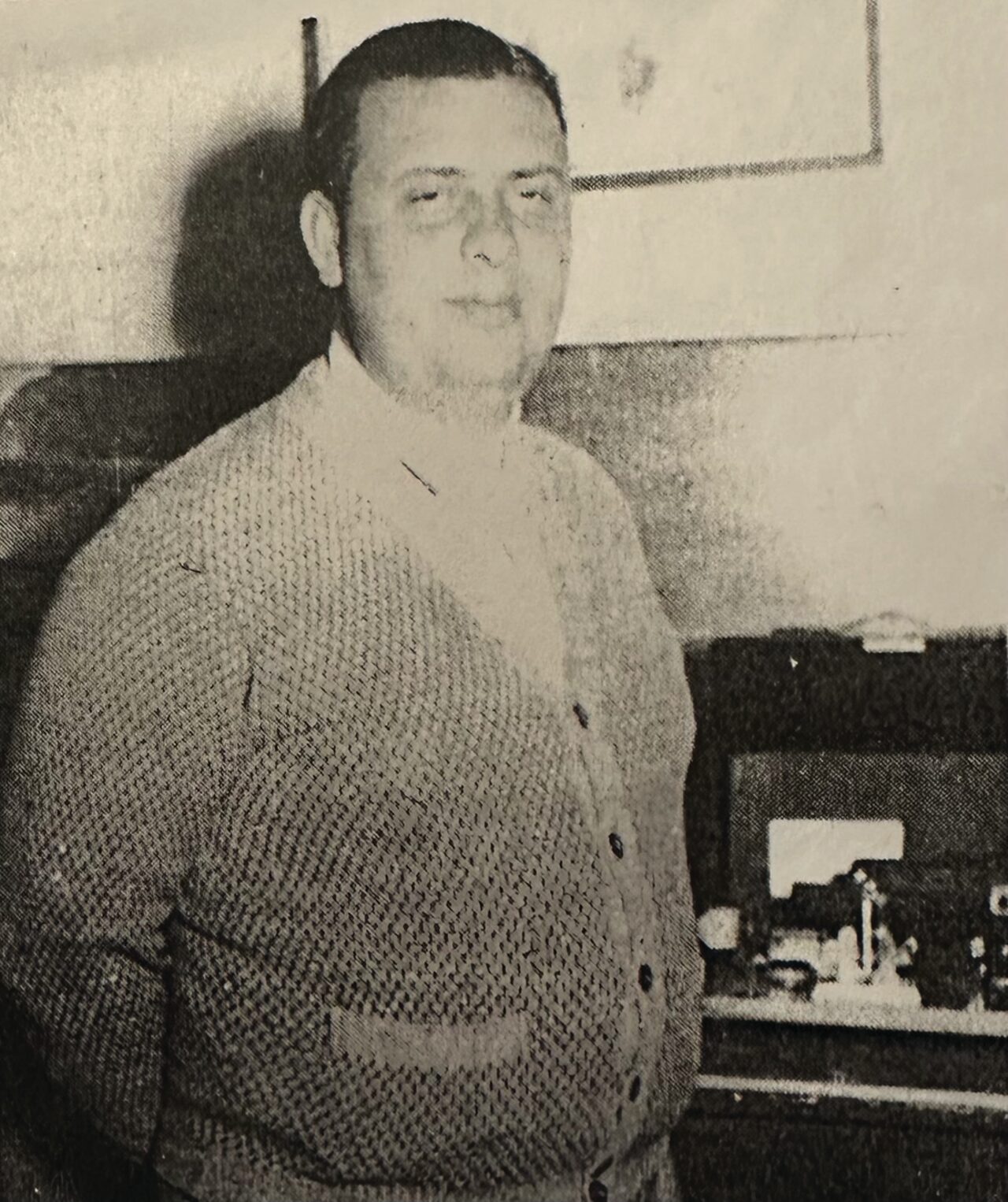
Audley Brodbeck as a young man.
When Bert Hassan started his electric welding shop in 1934, in the lane behind Hawke and Treloar’s (now the Civic Mall), the boys would be regular visitors, firing questions at the young apprentice Jack Cotton. They wanted to know all about the art of electric welding, the voltage and current used and where the power was coming from. With Aud’s hunger for knowledge, the mates were also regular visitors to Radio Station 2MO where they found an ally in founder Marcus Oliver who stripped down some old radios and gave them the parts to experiment and make crystal sets.
Aud left school in 1938 and couldn’t find a job, so he decided he would have to become self-employed. When he picked up a booklet advertising an engineering course, he made it his dream to educate himself, signing up for the course at a cost of 54 pounds, which he paid off at 10 shillings per week.
Aud was rejected for service in World War II because of his poor eyesight but it made him even more determined to finish his course. He used a magnifying glass from a hurricane lamp to study for up to six hours a day and helped around the guest house his parents had purchased after selling the Mary Elizabeth Café they had owned opposite the Civic Theatre in Conadilly Street.
In 1942, the Brodbecks bought a house in Tempest Street and Aud’s father began a shearing contracting business, employing several shearers, while Aud did the book-keeping at night.
In the early 1950s Aud was one of the first people to own a tape deck and was soon in great demand from people wanting to record their songs and music. He set up a recording studio over Keith Riley’s photographic studio in Marquis Street. After recording music on a tape, Aud would play it through an amplifier and the recording lathe would transfer the music onto a 78rpm recording blank.
When Phil Furley came to town and bought the Imperial Hotel, Aud would record the entertainment every Wednesday night to be played back to customers on the Saturday.
The following year, Aud achieved his dream and completed his course and then set about raising money to start his own business, growing tomatoes and other vegetables on the old tennis courts next to the house, while doing radio repairs on the kitchen table.
After two years of back-breaking work, Aud had raised enough money to build a double garage with a workshop stocked with testing gear and tools. The year 1944 was a momentous occasion for the ‘little Aussie battler’ when he received his radio engineer’s diploma, however, due to the war, there was a great shortage of some parts. Aud continued to develop a loyal band of customers as his reputation for reliable repairs grew.
After the war, Aud purchased stocks of new batteries and radio parts and installed a battery charging plant. In 1947, he designed and built a signal tracer that traced faults much faster. By waving a probe over the wiring of the radio he could locate faults in 15 seconds, which meant he could complete more jobs each day.
With Gunnedah growing rapidly, some houses in the outer areas were having the power connected and Aud was kept busy changing battery radios over to power line operations which meant practically rebuilding the set.
For Aud, his growing business meant more than just money in the bank, it was a chance to prove that people with disabilities deserve respect – he was finding that he was now respected not just as a tradesman but also as a person.
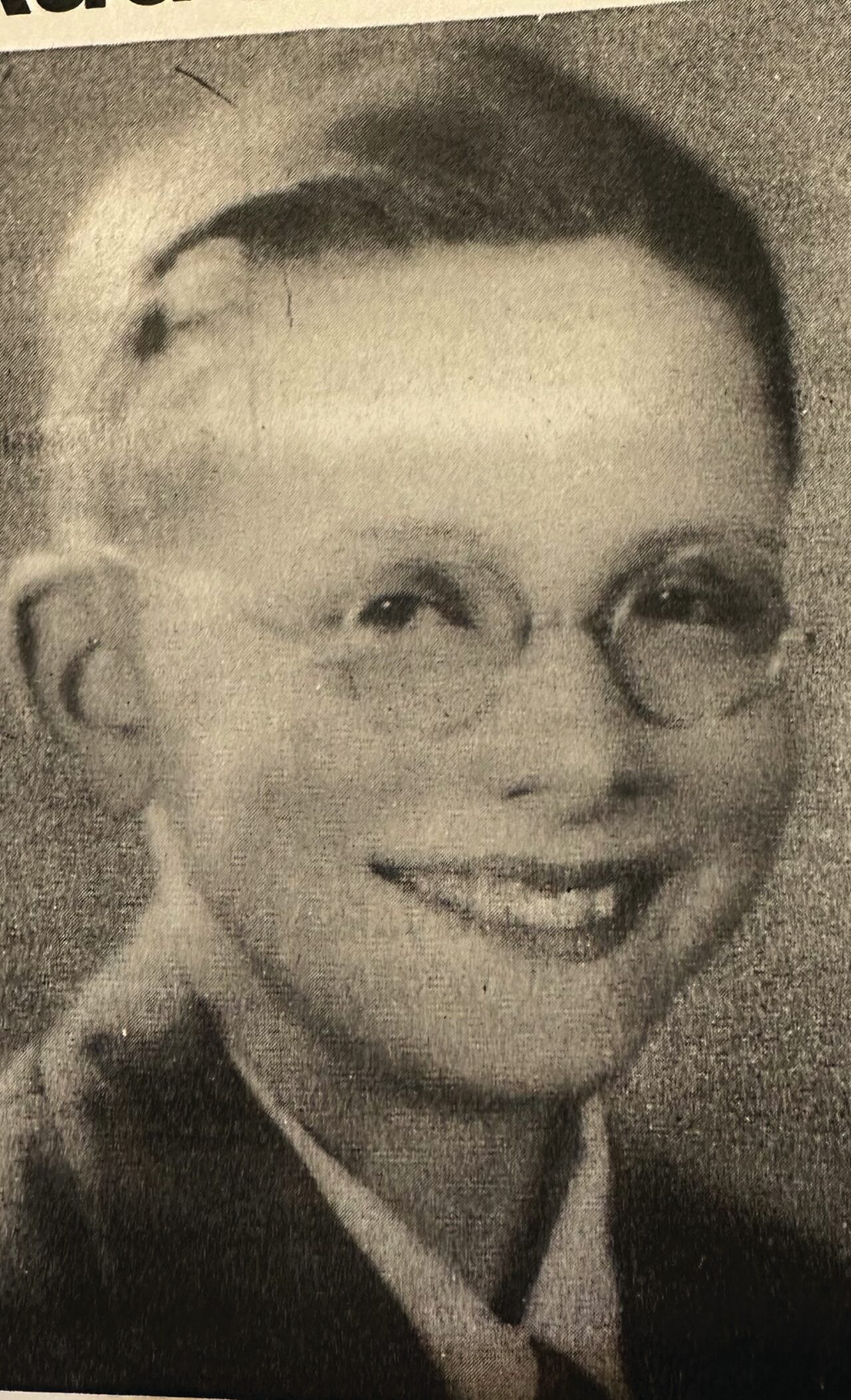
Aud Brodbeck at nine years of age.
Aud was also part of the fund-raising effort for the construction of the Gunnedah Memorial Pool when 2MO held a four-hour show to raise the finance for 2000 bags of cement. Aud recorded 11 artists in the studio and spent the day there operating the tape deck – the pool got its cement.
Tragedy struck in 1957 when a battery exploded in Aud’s face, causing cataracts to develop across his eyes and making it impossible to see the new miniature transistors coming into Australia.
When Aud’s parents purchased the old McDonagh’s general store in Carroll, Aud went with them. The 1964 flood devastated their shop and business and the family returned to Gunnedah with just the furniture they had salvaged before the floodwater drowned the store in four feet of water. There was no disaster relief money so the family was suddenly ruined and flat broke as the flood had caused thousands of dollars’ worth of damage.
When Bert and Connie Brodbeck decided to retire on the aged pension, Aud reluctantly accepted a disability pension and they moved into a house in Osric Street.
As a child, Aud had always wanted to learn music and although he had the opportunity to learn piano from May Howard, it wasn’t until he was sick with measles that he began to teach himself the mouth organ and later learned the piano accordion with his uncle.
Aud remembered one of the colourful characters arriving in town back in 1938, when Merv Beh stood on the corner one Friday afternoon and played the accordion attracting large crowds to the family café where he had volunteered to play for the price of a meal. When he agreed to play on 2MO and promote their café, Marcus Oliver was so impressed he gave him a job running the Smilers Club as well as a midday request program. After settling in to 2MO, Merv formed the 2MO Radio Dance Band which played for dances and other functions around the area until about 1941.
When the Brodbecks found themselves struggling on the pension, Aud and his father decided to make use of their musical ability and start a dance band which soon became popular, playing around the local dance halls with Nellie Kelly, Bev Kruse or Vera Howes on piano.
After about 10 years on the dance circuit, Bert Brodbeck was diagnosed with cancer and could no longer play and the band ceased to exist. Aud took up playing with the Gunnedah Musos and really enjoyed entertaining at a variety of dances and functions around the district.
Through his radio repair business, Aud met many wonderful people and all kinds of characters. He had the greatest admiration for Ted Newman, who was living with Multiple Sclerosis. Ted’s cheerful nature made a great impression on Aud Brodbeck and when the MS Society was formed in 1977, he became the secretary following on from the foundation secretary. Aud stayed in this position for four years, also serving as vice-president and continuing to work for the society in its efforts to find a cure for this serious progressive disease of the nervous system.
In 1973, Connie Brodbeck won a share in the Opera House Lottery and the family finally had its own finances to purchase a home in South Street. Bert Brodbeck lost his battle with cancer in 1979 and in 1990, Aud and his mother moved to Stock Road where she died three months later.
In a newspaper interview back in 1996, Aud Brodbeck had this piece of advice for young people: “Learn all you can about your chosen career while you’re still young and don’t shy away from the hard work that needs to be done to achieve your goal”.
Audley Brodbeck’s inspirational life ended on September 11, 1998, at the age of 75. He is buried at Gunnedah Memorial Park Lawn Cemetery.