


MORE than five decades of service and dedication with Fire and Rescue NSW has come to a close for Paul Hartley.
After starting his firefighting duties with Gunnedah Station 314 on 15 June 1974, Mr Hartley marked the end of his service last week and ended his tenure as a brigade deputy captain.
His name will now go in the history books as the station’s longest serving firefighter.

It’s an achievement that will take great difficulty for anyone else to surpass.
His extensive service was also acknowledged by Fire and Rescue commissioner Jeremy Fewtrell AFSM who called Mr Hartley personally to offer his thanks.
Mr Hartley reflected on the important service Fire and Rescue provides to the community as well as the commitment by its dedicated firefighters.
“I have enjoyed it immensely,” he said.
“You try to do the best you can.
“You are also trying to give support to people who are watching their whole world go up in flames.
“It’s not all flowers and lollipops.”
Mr Hartley has responded to a myriad of incidents, however a few stand out with one of the most notable being the massive Bestcare Foods pet food factory gas explosion in 2003.
The incident had such an impact on the community that the explosion was seen, heard and felt throughout the community.
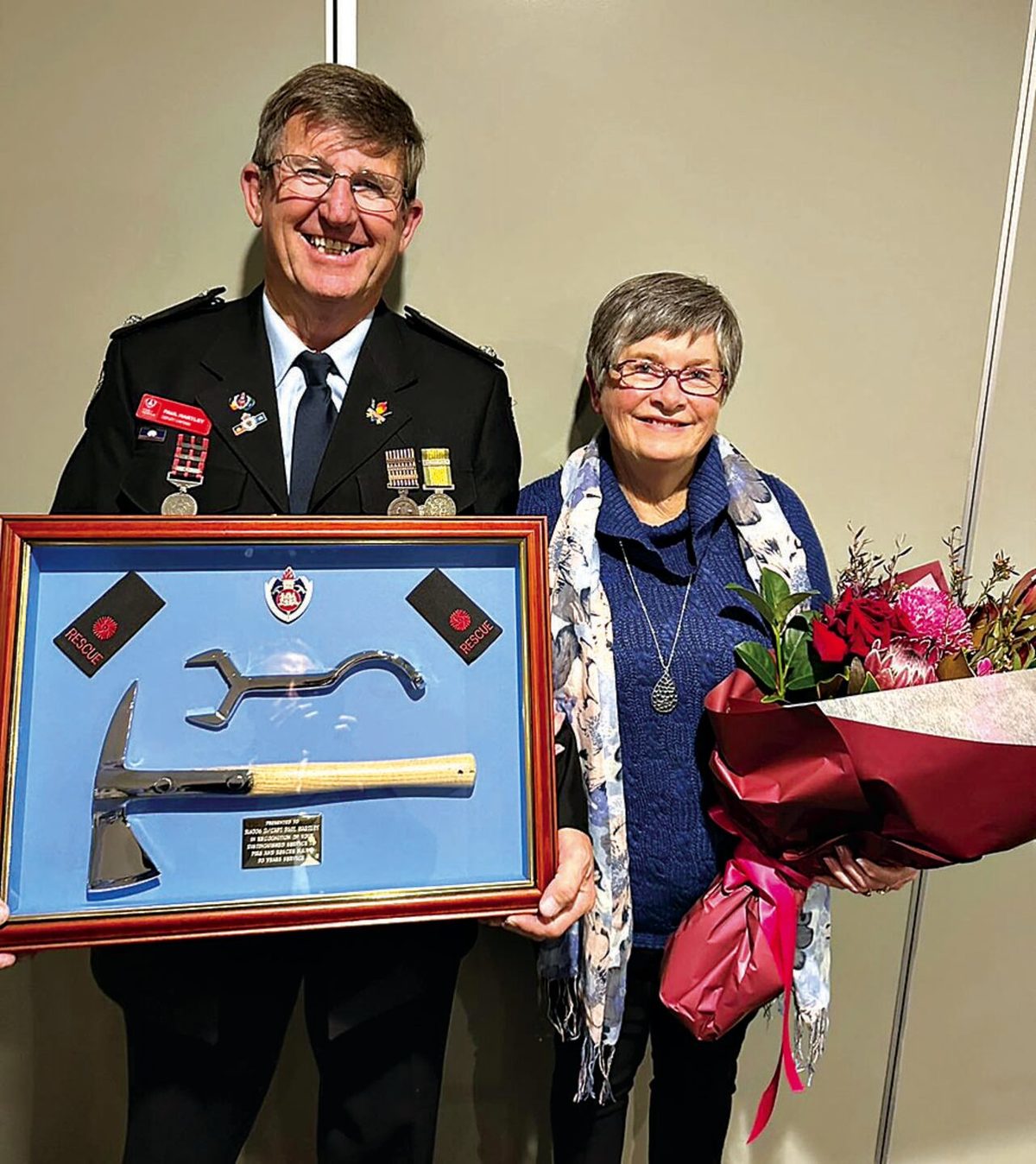
Paul Hartley, with wife Janise, when he was recognised for his 50 years’ service with Fire and Rescue.
“It was pretty bad. The first crew went in and thought it was gory,” he recalled.
Seeing red-tainted water at the site, Mr Hartley explained that they feared the worst.
“We thought there were people in there,” he said.
It turns out that the red colouring was the result of an additive used to manufacture the food.
Fortunately, it had been a long weekend and no factory employees were onsite.
The damage, however, was enormous with the explosion coming at a cost of millions of dollars and destroying the facility.
Mr Hartley also recalls a train derailment among the incidents.
He has experienced his fair share of vehicle incidents too, even planes.
Towards the end of his time with the service he could say he dealt with all forms of transport after responding to a boat fire at Carroll.
Over 52 years of service, Mr Hartley saw significant change in the service.
When he started his service, Gough Whitlam was Prime Minister, Robert Askin was the NSW Premier and Bill Clegg was the mayor of Gunnedah.
The service was also in its pre-Fire and Rescue period and was known as the NSW Fire Brigades.
Pagers were non-existent and alerts came through using different methods.
Mr Hartley recalled that a bell system was used in firefighters’ homes to alert them of an incident.
During the daytime, the siren would blare at the station.
The firefighters would respond, not knowing what emergency was unfolding.
Fast-forward to today, and Mr Hartley said the use of pagers gave firefighters an idea of what to expect.
“It gives you an idea of what you’re going out to,” he said.
Mr Hartley said an area that also changed was assisting on ambulance callouts.
At times, firefighters are called on to assist paramedics if required to assist in lifting or other non-medical components.
When asked if he had any advice for the service’s new recruits, he urged them to take note of the people already involved.
“They will share their experiences and will look after you,” he said.
“Make sure you keep an open mind.
“It’s a really good organisation for camaraderie.”
He described it as a friendship, of sorts.
“It’s a funny friendship,” he said.
“You’re not in each other’s pockets.
“But you’re there for each other.”
Mr Hartley said that camaraderie was something that had worked well for the Gunnedah brigade.
“We’ve always had a good brigade,” he said.
“I can’t praise them up enough.
“The crew will do well for Gunnedah.”
Mr Hartley said he had served under six captains, ending his service under current captain David Welch AFSM.
“They’ve all done their best for the job,” he said.
With his Fire and Rescue service at an end, Mr Hartley is still doing a day a week with his brother’s business, Hartley Electrical.
Mr Hartley praised local employers for allowing their employees to respond to their firefighting duties.
“They let their staff go to look after the callouts,” he said.
He also praised his own family, including wife Janise, and the families of other firefighters for the support they provide.
“Back at the start, we were on call almost 24/7,” he said.
With more downtime on his hands, Mr Hartley is looking forward to spending time travelling to see his children and grandchildren in Ipswich, Newcastle and Sydney.
“There’s plenty of work to do around the house for at least the next 20 years,” he joked.
“And I’ll still keep in touch with the boys at the fire station.”


