MARIE HOBSON, GUNNEDAH & DISTRICT HISTORICAL SOCIETY
While the glamour of railway travel must have been considerable when the railhead was first extended to Gunnedah in 1879, the coaching days remain as one of the most colourful aspects of Australian history.
The first coach service in the Gunnedah district was started about 1863, with most pioneering families before that time walking from Maitland beside bullock drays loaded with their personal household effects. Most early mail contractors delivered the mail on horseback.
The first mail coach to be used in the district was in 1868 on a section of the Gunnedah to Walgett run by RJ Nowland. He also had another important coach run between Gunnedah and Coonabarabran for the carriage of mail and passengers.
Robert Nowland had a large depot in Bloomfield Street near the current site of the Red Chief Motel. Some of his drivers were Dan and Jack Leary, Joe Bushell, Jim Power, RJ Nowland and the Nowland boys (Archie, George, Ted, Frank and Harvey), Phil Burns and his son Tom.
An old schedule discovered when the stagecoach depot was demolished, dated 10 May 1872, shows the following departure and arrival times: Depart Gunnedah at 1.45pm, arrive Boggabri 6.15pm, arrive Narrabri 3.15am, depart Narrabri 3.45am, arrive Wee Waa 7.45am, depart Wee Waa 8am, arrive Walgett Tuesday 2pm.
Historical records reveal that there was a service three times per week between Gunnedah and Coonabarabran for 30 shillings ($3) each way. On this run, a four-horse coach was used with three stopping places for changing horses.
In 1869 John Gill used a four-horse coach on the Murrurundi-Gunnedah run. Gill and Nowland covered so much territory in the North West that Cobb and Co. did not start in the area until 1874.
The first coach service between Tamworth and Gunnedah started in 1873. By 1874 there were 40 mails received and dispatched weekly at Gunnedah. Historical records show that Robert John Nowland, was principal of the coaching company, and is listed as one of the original trustees of the new racecourse, which later became the showground, along with hotel-keepers Patrick Hurley and Mark Turner, John Edward Higgins and Thomas Henry Buckley McGee.
By the early 1880s, Robert Nowland owned several mail contracts and passenger lines that stretched 400km north to St George.
Another historic photo of the coaching days was taken during filming of The Lure Of The Bush, a silent film, most of which was shot on the Gunnedah district properties Kurrumbede and Coulston on the Namoi River north of town. Gunnedah was selected as the location because the star Snowy Baker was friendly with the Mackellar family, of Kurrumbede.
The film includes a scene shot at the back of Mornington in Gunnedah – an attempted stagecoach robbery. The stagecoach was driven by local resident Harvey Nowland, who tries to escape the lone bushranger galloping alongside. Snowy Baker is a passenger. He climbs onto the roof of the stagecoach and springs at the bushranger, knocking him from his horse.
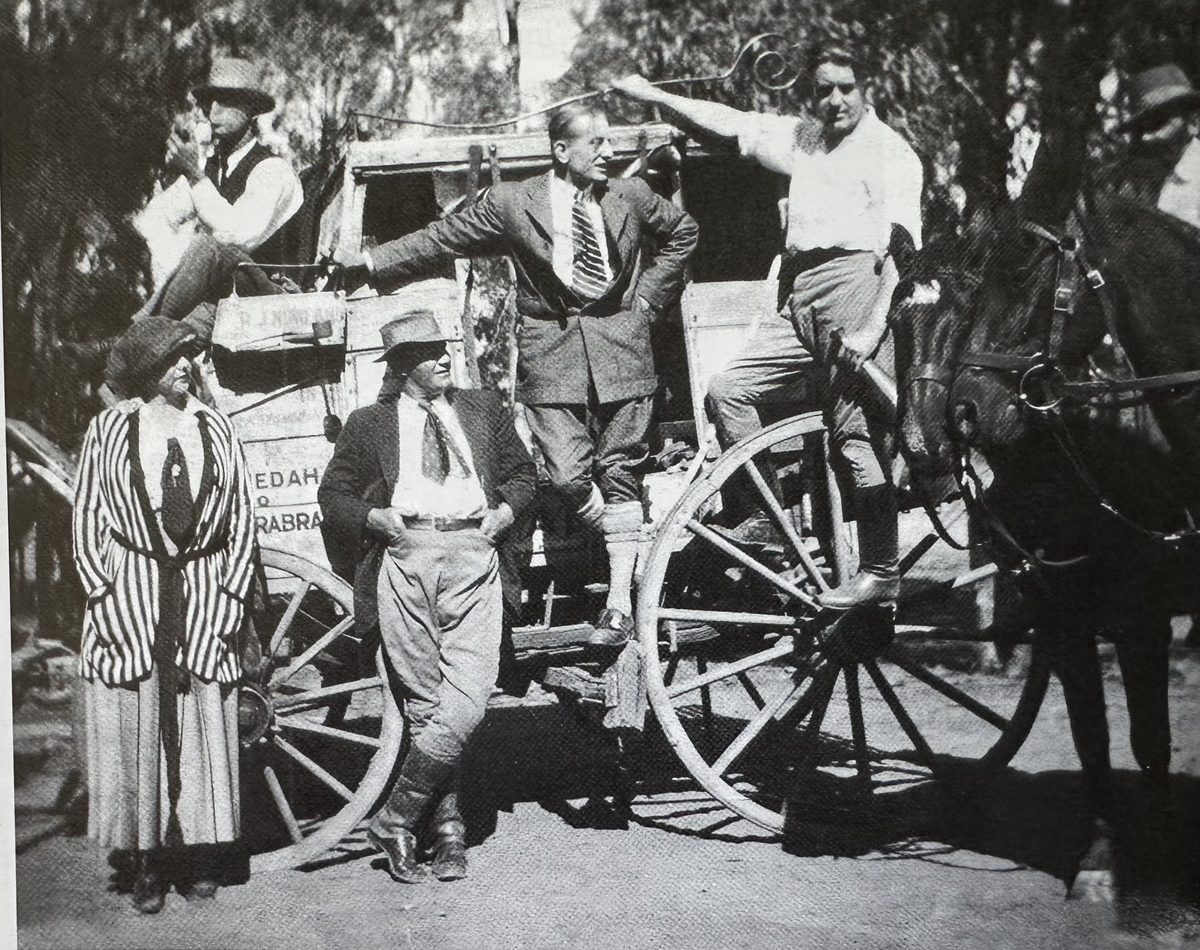
Another historic photo of the coaching days was taken during filming of The Lure Of The Bush, a silent film, most of which was shot on the Gunnedah district properties Kurrumbede and Coulston on the Namoi River north of town. Gunnedah was selected as the location because the star Snowy Baker was friendly with the Mackellar family, of Kurrumbede.
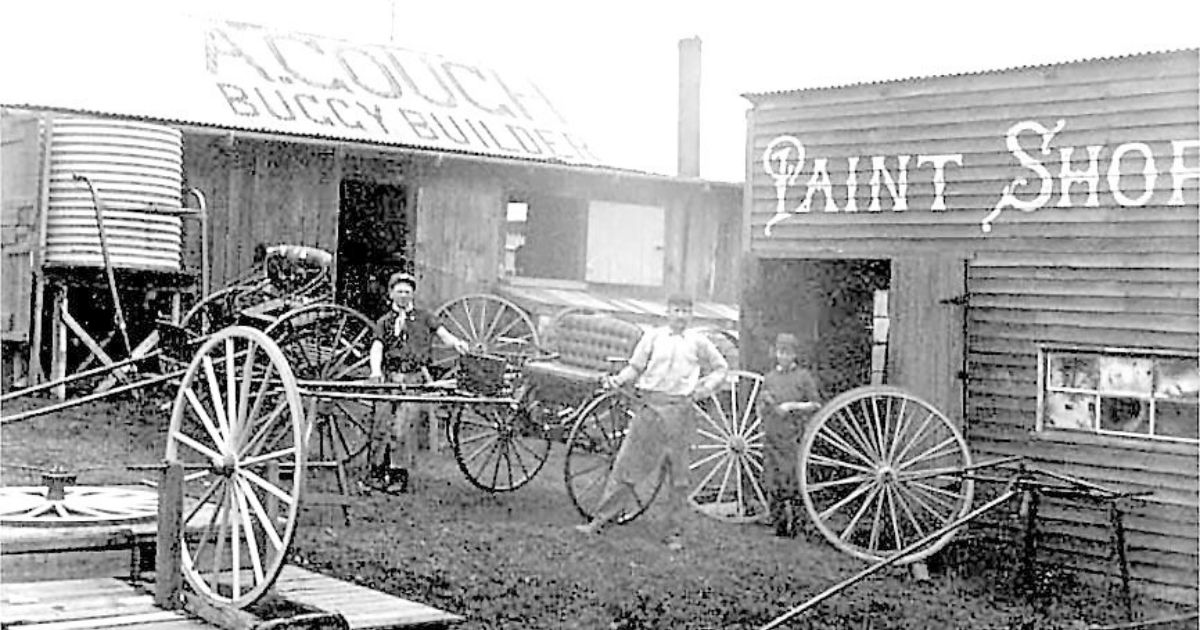
A prominent coach builder in Gunnedah was English-born Frederick Gough, who came to Gunnedah in 1872 as the Anglican Vicar. He was born in Somersetshire in the UK in 1837 and studied for the church at St Aiden’s College, Liverpool. Ordained by the Bishop of Worcester in 1864, he was appointed to St Thomas Church, Coventry, in Warwickshire.
He came to Australia in 1872 and was appointed by the Bishop of Grafton and Armidale to Gunnedah and Liverpool Plains district. In the late 1870s he resigned his charge after a disagreement with the Bishop and in 1880 bought Ruvigne from James Rigney. He sold the property to THH Goodwin in 1890 and then established a coach and buggy factory in Gunnedah with his sons, including Aubrey Gough, who was also a photographer with a business in Maitland Street.
It is not clear, however, if Frederick Gough was involved in the manufacture of Nowland’s coaches. He died at Royal Prince Alfred Hospital in Sydney in May 1894, leaving a wife, five sons and a daughter.
With the extension of the railway to Gunnedah in 1879, mail services were re-organised and there was a reduction in coach services.
In 2011, one of Nowland’s coaches was featured in an exhibition at the National Museum of Australia in Canberra. The story of Nowland’s Mail Coach was told through the theme of Connecting The Nation, one of 10 themes of Australian history within the Landmarks Gallery.
Curator Isa Menzies said Nowland’s coach had thick folds of leather to act as suspension, rather than the traditional metal springs of English coaches. The technology had been developed in the United States to suit the frontier conditions of the time and proved perfectly suited to the Australian outback.
The Nowland’s Mail Coach had been in the National Museum of Australia collection since 1980, when it was purchased from the Royal. In 1957 the RAHS lent the coach to the J. Arthur Rank Organisation for use as a prop in the movie Robbery Under Arms. The RAHS in turn had the coach donated to them by Edward and Daniel Carroll, who collaborated with versatile sporting identity Reginald (Snowy) Baker on several films including The Lure of the Bush (1919) and The Man From Kangaroo (1920), which both featured appearances by the coach partly filmed around Gunnedah.
“This coach once stirred the dust of the rough bush tracks that stretched from Gunnedah to Coonabarabran, a team of four horses pulling it through the day and night,” Isa Menzies said in the article. “An acetylene lamp was used to lighten the darkness, as the journey took around 12 hours – the sound of the coach’s bugle echoing through the darkness would have been welcomed by settlers as it stopped by each property to deliver mail and the driver would share news and gossip, and perhaps a cup of tea.
“As a curator it is always a kick to discover something new about an object, especially when it helps to fill in a gaps – under the right light you can just see the lettering spelling out GUNNEDAH and COONABARABRAN. It is reported that in 1917, RJ’s son Harvey had introduced a motor car to the route but was still required to use the coach in the event of inclement weather.”
The article stated that Robert Nowland had gone broke by the mid-1880s but despite his financial problems the Gunnedah to Coonabarabran run continued until 1919.
To order photos from this page click here