


A significant anniversary passed by quietly on October 28 which marked the official opening of Keepit Dam by then NSW Premier Bob Heffron 65 years ago.
The grand opening in 1960 was the culmination of agitation extending over a period of more than 60 years for greater certainty in the supply of water for stock and irrigation purposes along the valley – and also flood mitigation.
Keepit Dam was a saga of hopes and disappointments, of breakthroughs and setbacks, ultimately crowned with success, with the storage becoming the catalyst for massive agricultural development along the full length of the Namoi Valley.
Agitation for a dam at Keepit started in the 1890s and in 1896 an officer of the irrigation commission of the time was sent to the North West in search of a possible site for an irrigation scheme on the Namoi.
He had travelled only a short distance upstream from Carroll when he found what he considered an excellent site at Keepit, where the river broke through a chain of low hills.
At the time, sites were also under investigation for an irrigation scheme in southern NSW.
Following the 1902 drought, when the Namoi and Peel Rivers were reduced to waterholes, several enterprising land-holders set up irrigation plants on the Manilla River, Donald McDonald and John Barling installed plants which allowed them to produce tobacco and vegetables and establish dairies.
The success of tobacco-growing underlined the potential of irrigation, although there were no further developments in irrigated cropping.
Then came World War 1 – and everything else was left in the shade.
In 1919 a drought and a rabbit invasion laid waste a large part of the north, causing stock losses and crop failures. The proposal to dam the Namoi and drought-proof the valley was brought back onto the agenda in a series of articles in the Manilla Express by a Mr AR Macleod.
An irrigation league was formed in Manilla and the Department of Public Works sent engineers and surveyors to examine possible sites for a dam, including Keepit, though the head of the team, a Mr McTaggart, thought that Blue Hole, 20km above Manilla was a better site.
Both sites were surveyed and a conference in Manilla was attended by 50 delegates from all centres along the valley.
At this conference, however, the Minister for Irrigation, Mr Thorley, threw a spanner in the works by claiming that irrigation schemes in southern NSW and northern Victoria were producing more than Australia could consume or sell abroad. He said that further construction would be a waste of public money unless some source of production could be devised that would open up new markets.
The Great Depression also intervened to scuttle any further consideration of irrigation schemes, although surveys continued.
The catalyst for the construction of Keepit was a political argument which occurred in 1937. The Stephens Government in NSW became embroiled in a bitter internal dispute, a breach which was eventually healed by the intervention of Colin Sinclair, Minister for Lands and the Member for Liverpool Plains.
Sinclair’s “price” for his peace-making effort was a commitment from the government to proceed with the construction of Keepit Dam. The Blue Hole proposal was quickly scrapped.
A conference in Narrabri emphasised the alarming decrease in artesian water levels in the region and during the conference, the Premier, BS Stevens, gave an undertaking that the government would proceed immediately with the construction of Keepit Dam.
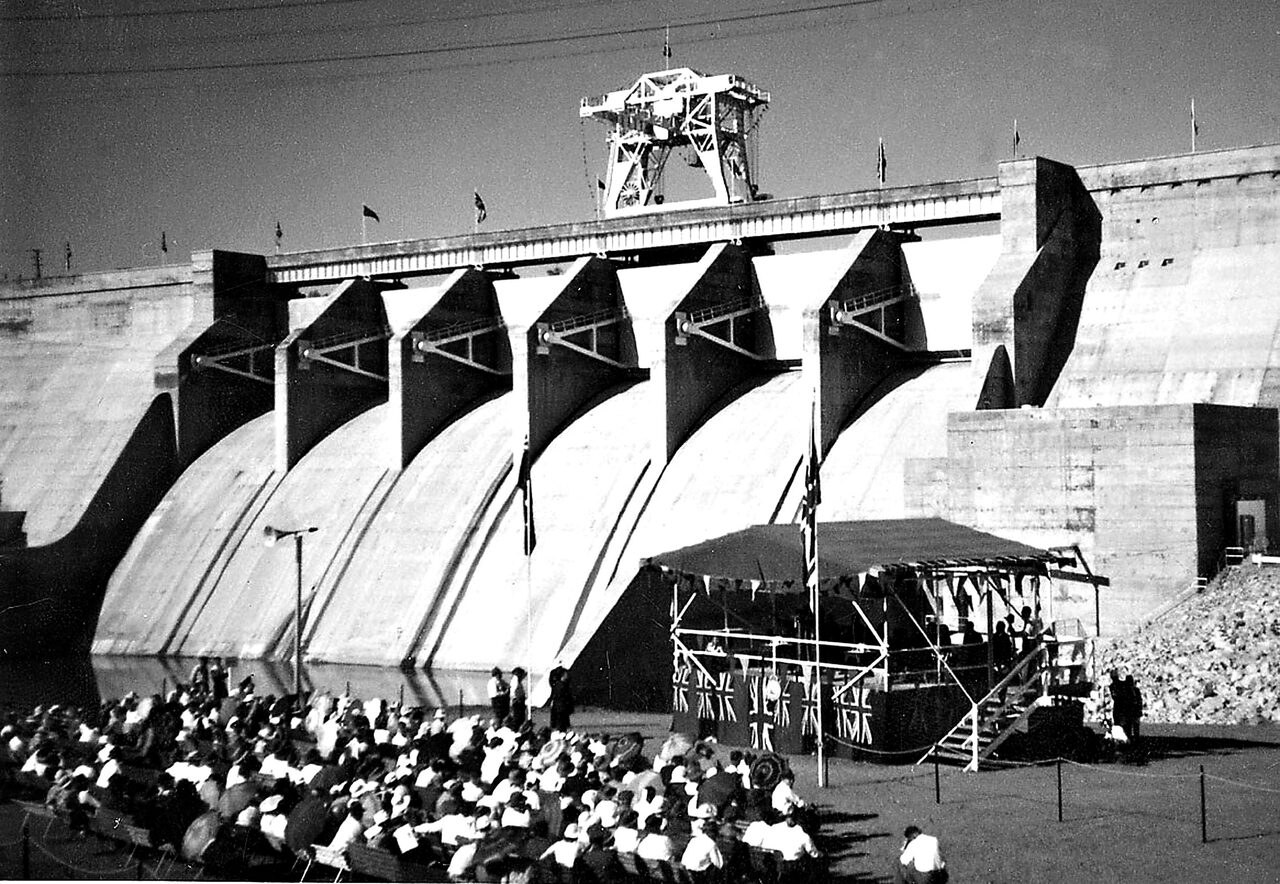
Official opening of Keepit Dam on October 28, 1960. The opening was performed by the Premier of New South Wales, Bob Heffron.

Stages of progress on construction of the dam wall. Main structural work was resumed in 1955, just before the arrival of the record flood, and was completed in 1960. The dam was officially opened in October that year.
Soil erosion had become a major problem in the Manilla district and properties were honeycombed with deep channels, with valuable topsoil washed into the Manilla and Namoi Rivers.
As a result, there were grave concerns that, as the Manilla district was the catchment area of Keepit Dam, the dam would fill up and become a silt bed.
To combat the threat, a soil erosion station was established at Gunnedah after the war, with branches at Tamworth and Manilla, and soil erosion prevention strategies were put in place.
Work had resumed on the dam construction by the late 1940s but once again it was scaled down and in 1953 it appeared that the project would be abandoned.
The State Government announced the cessation of work and dismissed 140 workers, saying that it did not have enough money to complete all the public works that had been started.
The announcement caused an outcry in the north and led to a public protest meeting in Gunnedah on July 24, 1953, when the Town Hall was bursting at the seams.
Construction of Keepit was wound back as the government allocated its meagre resources to the completion of Burrinjuck and Glenbawn Dams but by September 1956, 44 percent of the concrete required for the main wall at Keepit had been placed, despite the dislocations caused by two major and five minor floods.
In January 1957 the Namoi River was diverted at the Keepit site, as the final phase of construction began.
In March 1958 the Keepit National Trust was formed with representatives from all the major centres in the area and the following year massive working bees were organised to fell trees in the lake bed for aquatic activities when the dam began filling.
Keepit Dam was completed in June 1960 with the installation of the last of the six huge 14.9 x 11.8-metre floodgates.
At the official opening, Premier Robert Heffron, told the large crowd assembled at the foot of the wall, the project had cost 12 million pounds, a modest sum for the enormous benefits the dam would provide for stock and irrigation development in the valley.
Construction of the dam generated enormous enthusiasm and opened up new horizons for people living in towns nearby.
The Apex movement co-ordinated a huge voluntary effort which culminated in the opening of the Fitness Camp in November 1961.
The Manilla Shire Council was given land to develop as a park and picnic area for boating, skiing and fishing enthusiasts and the Manilla Ski Gardens, of 32.3 hectares, was officially opened in 1962.
A pivotal factor in irrigation development in the valley was the first commercial planting of cotton by Californians Paul Kahl and Frank Hadley near Wee Waa in 1961.
Research at the Myall Vale Agricultural Station and trials conducted by plant breeder Nick Derera had caught the eye of Kahl and Hadley, who purchased land and, in their first year, planted a “cautious” 28 hectares (65 acres). It was the signal for an explosion in cotton and other irrigation development in the valley.
Within 10 years 25,000ha (60,000 acres) of cotton were under irrigation and today the valley has 42,000ha under cotton and a similar area sown to wheat, sorghum, lucerne, pasture, vegetables and oilseeds.
But it hasn’t all been plain sailing – during the 1966 drought the dam water level fell to four percent. It was even lower in 1994-95, falling to one percent of capacity. As the drought continued to shrink the water level, some of the history of the area, hidden for more than three decades, was again laid bare. The old Keepit cemetery resurfaced and on the former property Huntsgrove, owned by the Bank of NSW before reclamation, an old sulky, fence posts and the remains of the old homestead became visible for the first time since 1960.
But nature has a way of restoring balance and by early 1996 the dam was “brimming” again.
In recent years, plans have been developed for an expanded structure capable of meeting modern requirements for very large to extreme floods and earthquakes.
Though dry times and irrigation demands have again reduced the level to less than 20 per cent of capacity, Keepit remains a popular recreational facility for regional residents.
Behind the 55-metre-high face of the dam, 420,000 megalitres of water at capacity point form a 4370ha lake with a 104km shoreline when the dam is at top water level.
Those far-sighted few of 120 years ago would never have believed their eyes.
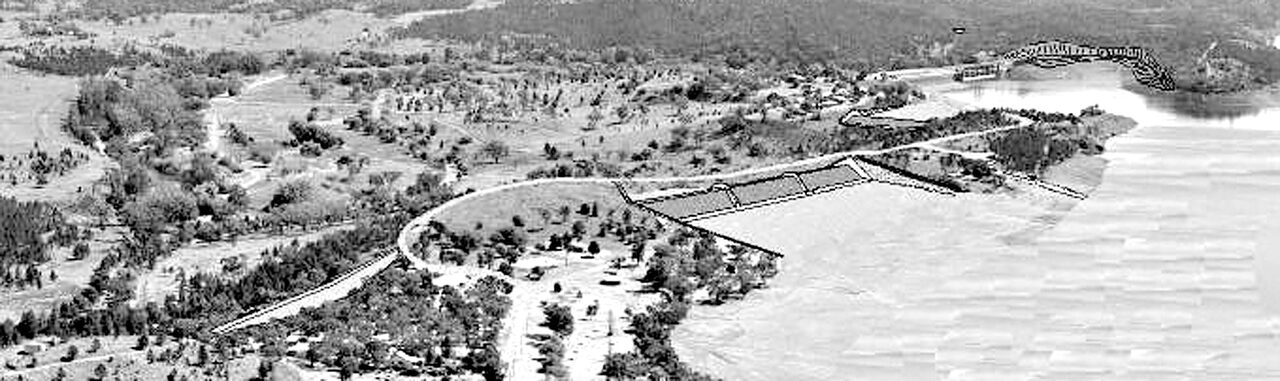

Work on the main wall.


