


WHEN the iconic sculpture of acclaimed Australian poet Dorothea Mackellar was unveiled on Australia Day 1983, it was with mixed emotions that deputy mayor Mientje (Mikie) Maas saw her dream come true.
Unfortunately the mould for one of the horse’s legs had broken in the studio of sculptor Dennis Adams a few weeks earlier, but with acclaimed poet Rosemary Dobson locked in for the launch, it was decided to go ahead with the ceremony.
As a result, the sculpture of Mackellar was seated on a hessian-covered box placed in the middle of the pool lined with stones from the Namoi River.
According to a newspaper report of the day, no one seemed to mind that the statue was unfinished. In fact, most people were impressed.
The important occasion attracted representatives from national newspapers and magazines, while film crews spent several days in the area preparing a documentary on Mackellar’s country and Maas, who was the driving force behind the sculpture concept. Among the special guests was the principal of Koorawatha School, John Butcher, whose school had raised the most funds for the schools’ appeal.
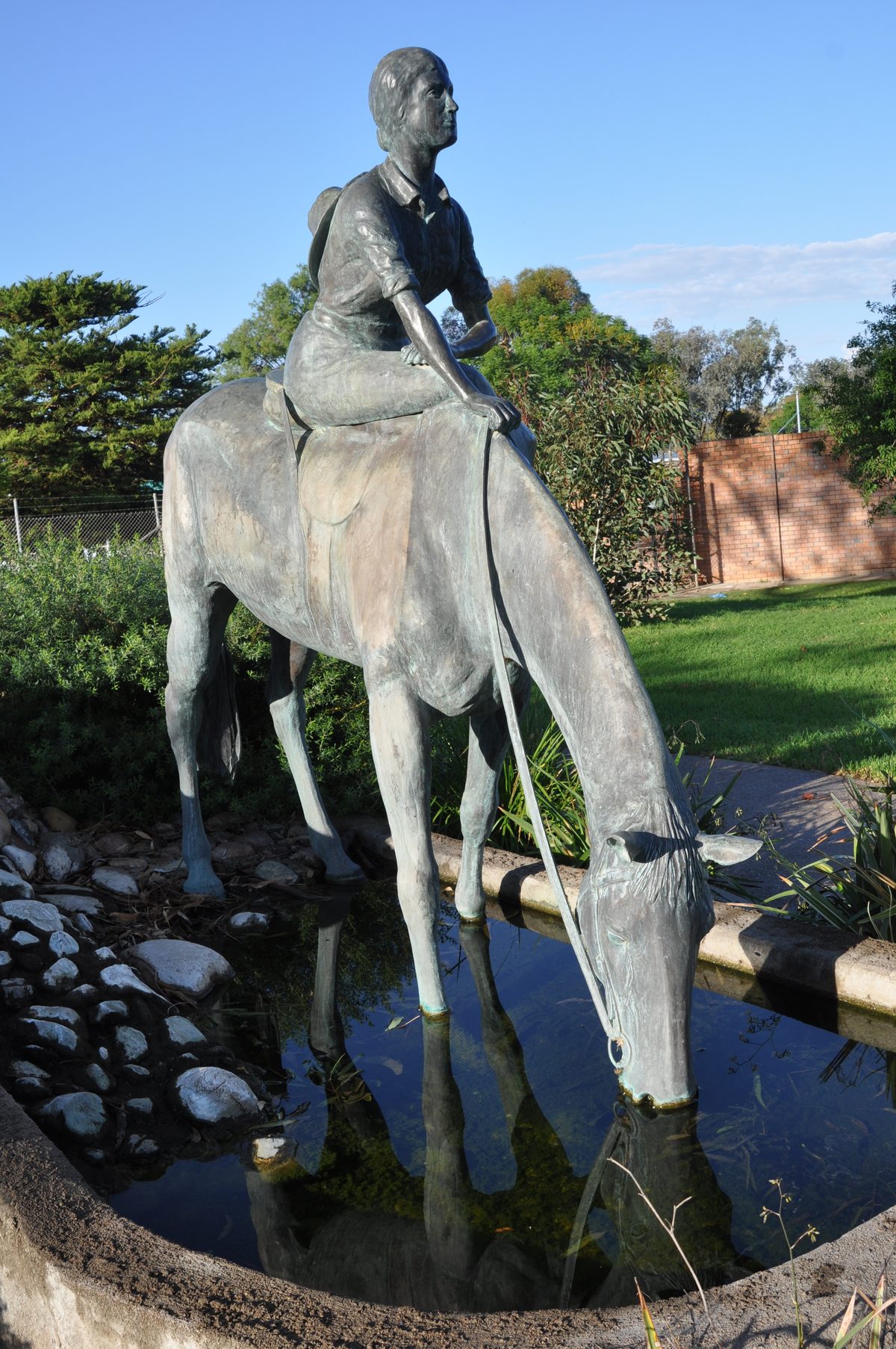
The iconic sculpture of Australian poet Dorothea Mackellar was unveiled on Australia Day 1983.
Speaking at the unveiling, Dobson praised Gunnedah’s “gallantry” in honouring Mackellar.
She said there was a close parallel between the words of My Country and the state of the district at that time.
The poet said that Mackellar had achieved something many poets greater than she had not been able to do – that is to capture the imagination of a whole people, giving her countrymen the words to express their deep feeling of attachment to their land.
After the ceremony, the unfinished statue was taken back to Sydney to be completed in the sculptor’s studio and it was a day to remember when the completed sculpture was installed at Anzac Park on 13 September 1983.
The project began as a small seed of an idea back in 1980 when the Dorothea Mackellar Memorial Committee, led by Maas, began a two-year slog to raise funds for the sculpture.
The committee members raised more than $26,000, never losing their enthusiasm.
The state government’s refusal to provide a matching grant came as a great blow, although the then premier Neville Wran had given Maas a strong indication that funds would become available.
Never one to take “no” for an answer, Maas pushed on with the project, attracting national press in the form of newspapers, magazines and television coverage, with donations pouring in from all states and even across the seas in England.
Maas summed it up by saying that “the fundraising had been very hard but satisfying”.
Despite the negative comments of those who said “it couldn’t be done”, an estimated 800 people turned up for the unveiling of the memorial plaque.
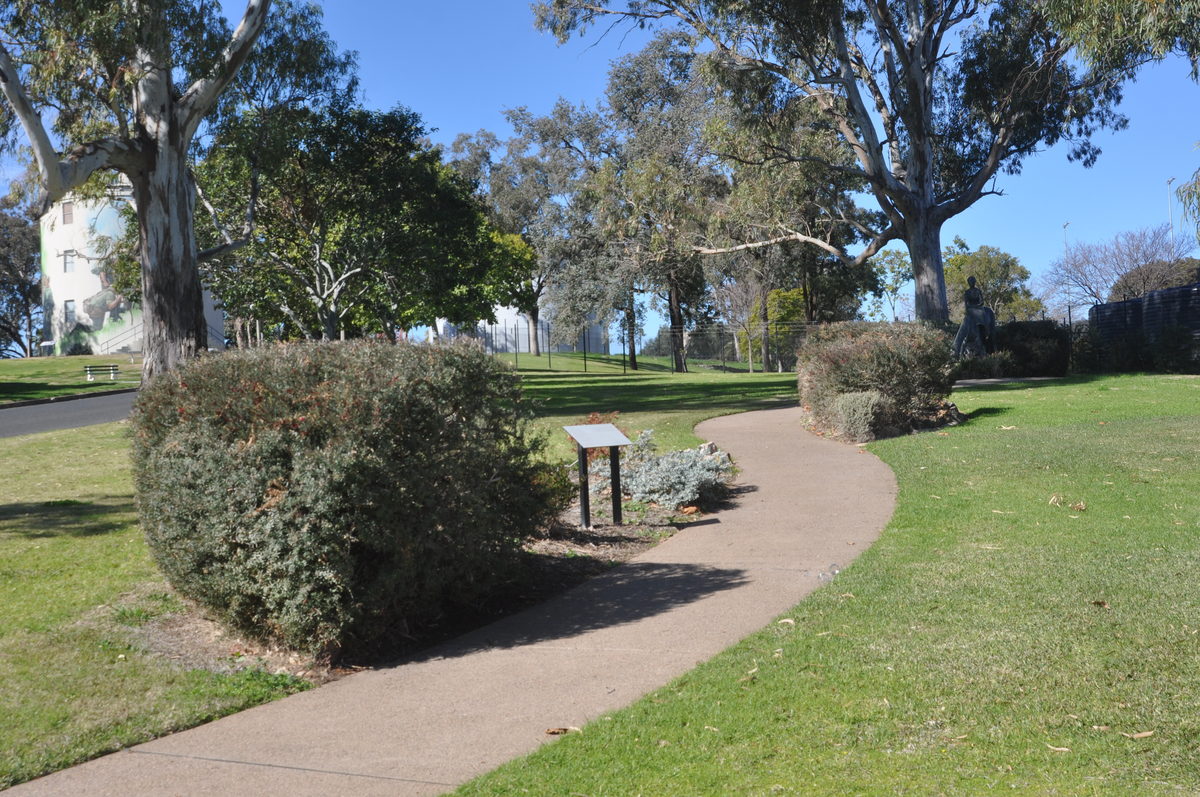
Maas Walk was dedicated to Mientje (Mikie) Maas on the 30th anniversary of the Dorothea Mackellar Memorial Society and Poetry Awards.
A feature of the unveiling ceremony was the singing of My Country by a local children’s choir conducted by Marie Spinks and accompanied by musician Ross Fiddes.
On hand to witness the historic event was Gunnedah’s Citizen of the Year, Maas, who could not contain her excitement.
“We had raised all the finance and I was starting to get worried,” she said at the time.
“Months passed and there was still no statue – I wondered what people were thinking. But all of that is over now, the statue is there and the sculptor Dennis Adams has done a magnificent job. I am sure it will become a very important tourist attraction.”
And so it has, with hundreds of visitors walking up the winding path named Maas Walk, dedicated to Maas on the 30th anniversary of the Dorothea Mackellar Memorial Society and Poetry Awards.
The pathway reveals three of Mackellar’s poems, with My Country and two others written about Gunnedah – Dawn and Burning Off.
In the following years, the sculpture appeared on souvenir envelopes with a special stamp, on the side of Meadow Lea margarine tubs, and with a brief resume of how Mackellar came to write her famous poem.
Mackellar’s connection to Gunnedah came about when her family purchased three properties in the district and she became a regular visitor, mainly to Kurrumbede on the Namoi River.
Dennis Adams, the man who created the Dorothea Mackellar Memorial, was a leading painter and sculptor during his lifetime.
Born in Sydney in 1914, he died on 9 February 2001.
Adams studied at the Royal Art Society, Sydney, and Royal Academy Schools, London. He joined the 18th Battalion and was later seconded to the Department of Home Security for camouflage work on RAAF stations. In 1942 he was appointed war artist before being made captain in the Military History Section AIF in 1943. He went on to serve in New Guinea, the Middle East, Italy, Egypt, the UK, France, Belgium, Newfoundland, Canada, the Bahamas, the USA and Japan.
After 1945 he continued to work as an artist, mainly in the area of war, and undertook numerous other works including the Royal Australian Regiment Memorial in Wynyard Square and paintings and sculpture at the Australian War Memorial in Canberra. In 1989, he was awarded the Medal of the Order of Australia.