Basketball became a competitive sport in Gunnedah 68 years ago, following a public meeting in the Police Boys’ Club hall on October 22, 1957 – the sport grew rapidly and the long and protracted fight to build an indoor stadium was realised 40 years ago this November.
The foundation president was Bill Hall, with Tom Toomey elected secretary and Graham Groth treasurer.
The committee members included Tony Juratowitch, Robert Leister, Barry Rodd, Adrian (Mick) Kleinschafer, Keiran Drew, Trevor Hart, Peter Horniman, Henry McCann and Colin Hobson.

The meeting took steps to construct a basketball court in Anzac Park, next to the railway line, applying to the shire for a donation of old decking from the Mooki River bridge for use as supports for the backboards.
A working bee was held a week later to clear the area of weeds and dig holes for the posts. The court surface was furrowed and graded, a tennis court roller was borrowed from St Joseph’s Catholic Church, which had courts in the church grounds, and lights were connected by the Namoi Valley County Council.
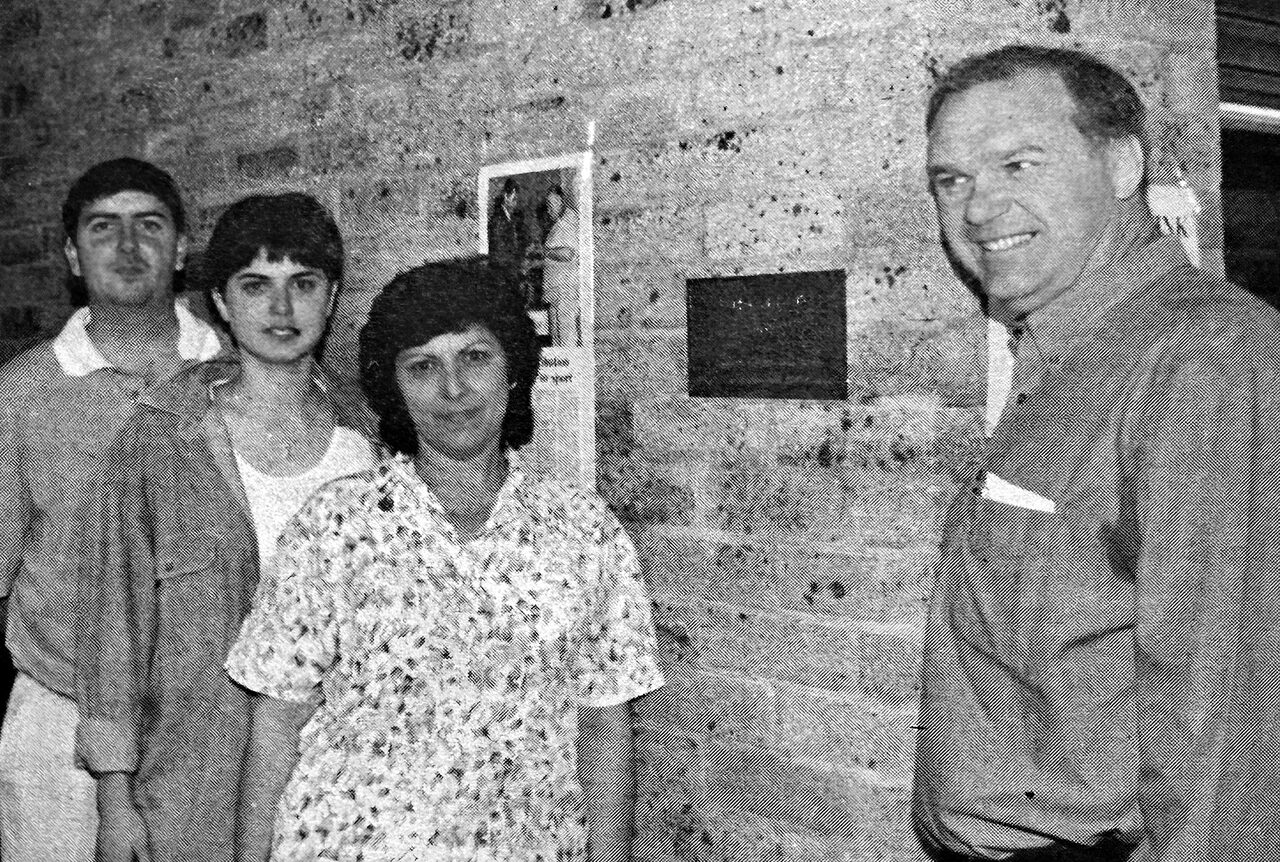
Chairman at the opening of the new stadium, Phil Brooks at the making of court 1 in honour of Con Barbato a great stalwart of the club. He is pictured with Con Barbato’s daughter Di Louis and grand children.
On December 18 that year the first games were played on the new court, which by today’s standards would be considered at best “primitive”.
The formation of the association came from a conversation at the Court House Hotel when someone said: “Why don’t we start up basketball?”
The fledgling group had to send away for rule books but, in true Gunnedah style, there was no lack of enthusiasm. The court had to be marked out each time it was used and the tennis court marker kept breaking down. Although the courts were rough and ready in the early days and the players inexperienced, they all had a great time – and great parties.
The court was tarred in March 1958 and the game started to make progress, becoming affiliated with the NSW Basketball Association that year when three delegates attended the first state-wide basketball conference at Narrabeen Fitness Camp.
The game continued to grow and in February 1963 a request was made to council to move the court to Kitchener Oval where basketball was played for the next 10 years.
Basketball went indoors in 1975 when Gunnedah Show Society approved a request for the use of the Griffiths Pavilion. Play started there in the September with 45 teams. The association purchased a scoring system for the Griffiths Pavilion in December 1976 and in May 1977 Life membership was awarded to Mac Gimbert and Terry Vinall.
Miniball was introduced in March 1978, broadening the club’s base, and Gary Louis and Kevin Elphick were honoured with life membership.
In the same year Rex Baldwin and Cliff Griffen became the first to receive their level 1 referee badges from the New England Basketball Referees Association.
In 1981 Kevin Elphick received an Australia Day sports medallion for his services to basketball with a similar award to Di Louis in 1983.
Judi Guest joined the Gunnedah Basketball Association as a player in 1974 and immediately put up her hand to take on the position of secretary when no-one else stepped forward. Judi was one of the founders of mini-ball which was a huge success in the 1980s.
She had a short break from basketball when her son was born but was involved continuously for 18 years, serving as coaching director, junior director, board member and secretary, until losing her determined fight against cancer in 2005. Judi Guest was honoured with life membership in April 2002, and after her death the building was named the Judi Guest Stadium in her honour.
Colin Sills became a life member in 1983, the year that basketball moved to better facilities at the Police Youth Club in View Street. Other life members include Di Louis (1986), Betty Sleath (1992), Rhonda Smith (1993), Sharon Boyd and Robyn Baldwin.
In March 1985 a steering committee was formed to investigate the construction of a basketball stadium and after a long and determined struggle, the two- court $590,000 stadium was officially opened on November 4, 1995, by national basketball star, Tonny Jensen, the Newcastle Falcon’s top-scorer in the 1995 season and member of the touring Boomers side. The No 1 court was named in memory of the late Con Barbato as a tribute to his tireless fund-raising for the new stadium.
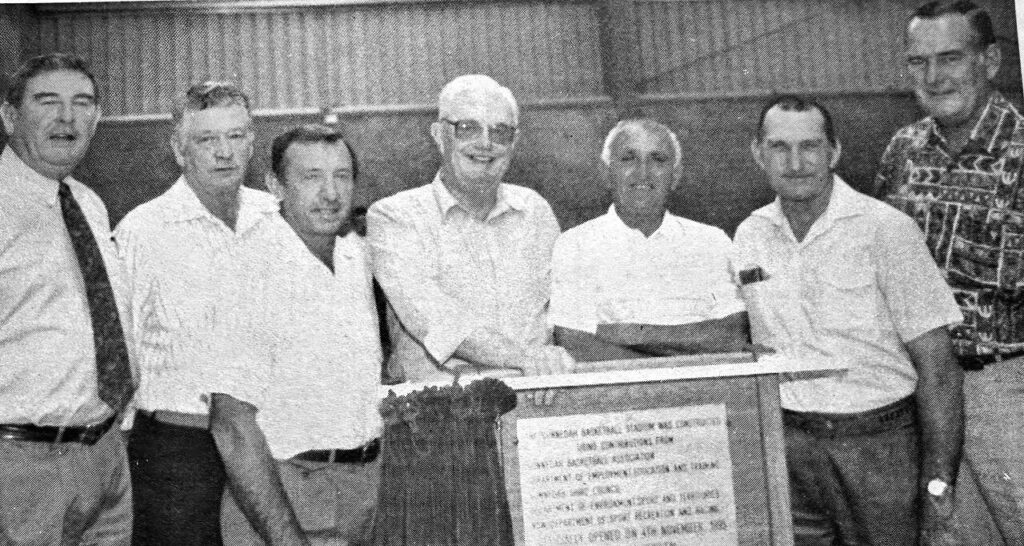
Pictured at the official opening of the stadium are ‘pioneers’ Bob Leister, Mac Gilbert, Col Sills, inaugural president Bill Hall, Des Dries, Col Morrison, Henry McCann.
Completion of the project capped a seven-year effort by local members who never lost sight of their goal, despite a series of setbacks.
The association had raised more than $100,000 towards the capital cost and sent $80,00 of this to the state body Baskcorp, expecting to receive further capital funds to allow the project to proceed. Gunnedah was next on the list for capital assistance but Baskcorp funds were frozen, leaving the project in limbo.
After a lapse of three years, local officials resurrected the project and there was a breakthrough in late 1994 when funding was obtained through the Department of Employment, Education, Training’s new Work Opportunities Scheme to allow the two stages to proceed.
Gunnedah Shire council pitched in with a grant of $122,500 and a loan of $122,500, the Basketball Association gave $52,000, DEET ($22,000), Department of Sport, Environment and Territories ($50,000) and Sport Recreation and Racing ($20,000).
The building was completed on time and on budget with local contractors and suppliers winning selection on competitive merit for almost all aspects of the project.
With management of the project by council and the incorporation of the work program, plus voluntary labour, significant savings were made.
If the project had been completed as a whole, the cost would have been at least $800,000.
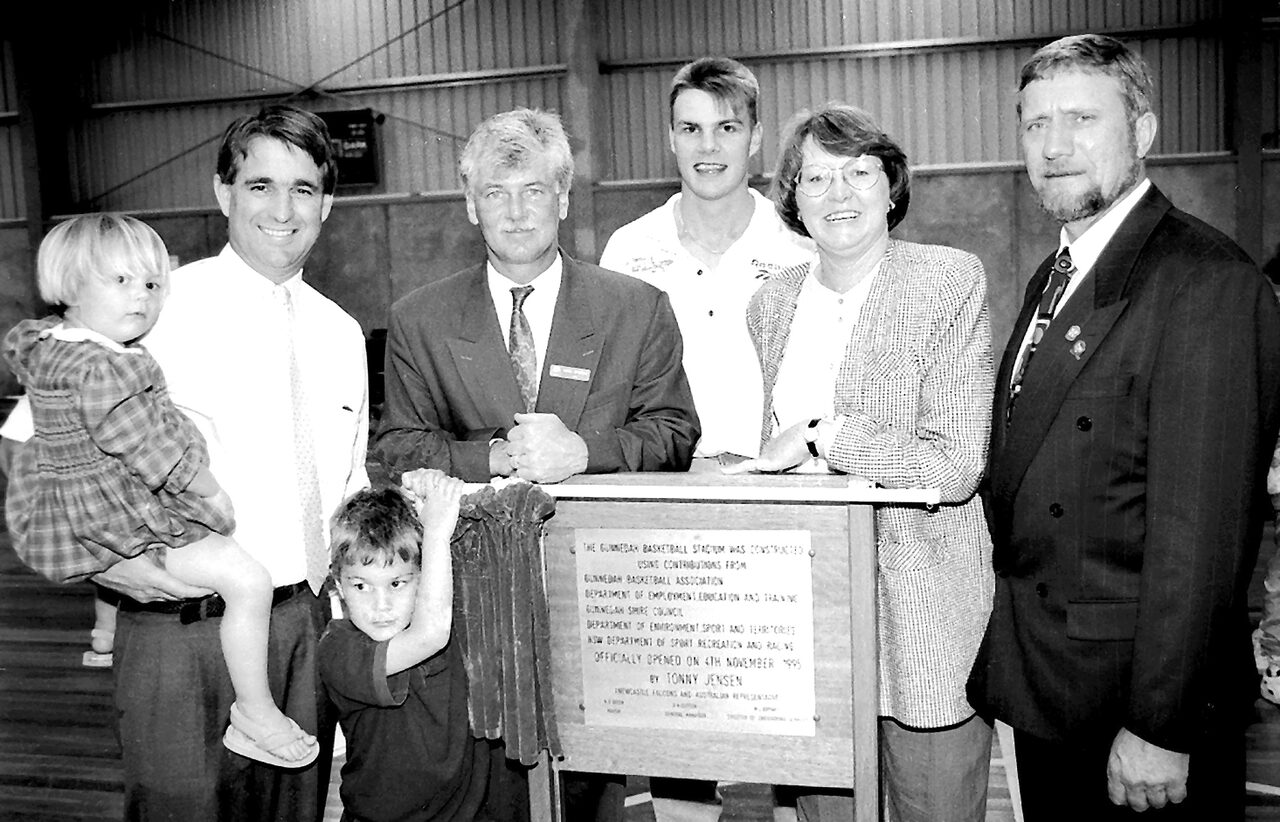
Official opening of the basketball stadium. Member for Gwydir, John Anderson, and children Georgina and Nicholas, Mayor Noel O’Brien, Newcastle Falcons’ star Tonny Jensen, Senator Sue West and Basketball Association President Owen Hasler.