MARIE HOBSON, GUNNEDAH AND DISTRICT HISTORIAL SOCIETY
Eulogies and obituaries often reveal previously unknown facts about a person’s life, with mourners often commenting that they had no idea the deceased had achieved so much in their lives.
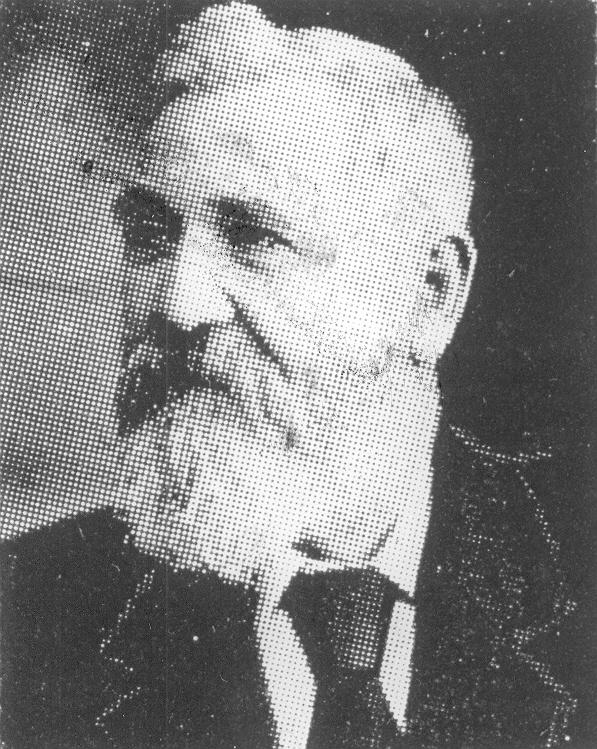
William Henry Pike was once such person, with his obituary on the front page of the Gunnedah Independent Advertiser on 7 January 1954 revealing a determined and brilliant mind, and the town of Gunnedah benefiting from his enormous contribution across a wide variety of organisations and projects.
Today’s generation can have instant heat and light at the flick of a switch, all due to the brilliant minds of the Pike family.
Known as the ‘Father of Electricity’ William Henry Pike was the eldest son of Henry Thomas and Mary Ann Pike. Henry Pike had served as an alderman on several occasions, was elected mayor in 1902, and was known as the ‘founder of Curlewis’.
Henry Pike was one of the town’s great pioneering mayors and was positively associated with three main advances in Gunnedah at the turn of the century: a permanent fire brigade, a reticulated water supply and electricity provided under franchise by Henry Pike and his sons.
The town of Gunnedah received its first electric street lighting in 1908, when the Pike Brothers sawmilling family replaced two old kerosene street lights with the new electric lights, on the Marquis and Tempest street intersections of Conadilly Street.
Henry Pike had established a sawmill on the corner of Barber and Marquis streets (now the Namoi Flour Mill and Presbyterian Church) some years prior to 1908. Sadly, he died shortly after being granted a franchise in 1908, in the deadly typhoid epidemic that swept the town.
From the sawmill’s steam engine, the Pike brothers had attached a small generator to light the mill and their father’s home nearby; this was the catalyst for the later supply of electric power to the town.
Recognition for the continuous electrification of the town of Gunnedah can be attributed to William Henry (Bill) Pike, who maintained the franchise to supply the town with electric power for a period of 37 years, until the Gunnedah Municipal Council purchased his operations in April 1945.
For many years Pike’s Power House was renowned for the twice-daily shrill of the brass steam whistle, at 1pm and 6pm.
The whistle also sounded at other times – to give an urgent summons to the local volunteer fire brigade, and in the 1939–45 war period, to signal a compulsory air raid practice.
Just after the death of their father Henry at the age of 64, on 6 June 1907, three of the Pike brothers, William Henry (Bill), Charles and John Robert ordered extensive electric generating equipment from England.
Unfortunately, John Pike also contracted typhoid fever and died on 12 March 1908, aged 28 years. He had trained as an engineer at Morts Dock in Sydney.
An article in the Tamworth News Newspaper dated 22 May 1908 revealed that the firm Siemens Bros. would be installing an electricity plant at Pike Brothers, Gunnedah.
This initial equipment came from Birmingham, England, and Mort Dock Engineering firm in Sydney, and was installed on land facing Little Barber Lane, between Marquis and Elgin streets.
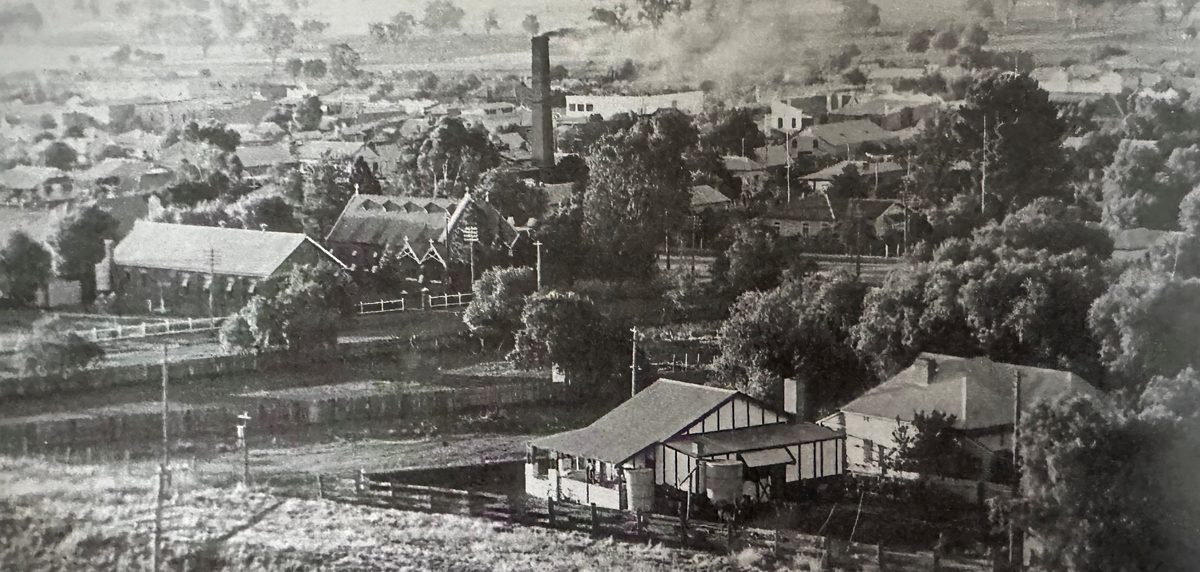
Pike’s Powerhouse pictured from Anzac Hill.
Pike Brothers obtained their initial franchise from the council for a period of nine years. Further plant was purchased in this period to cover increasing demand for power, although at this time supply was on a part-time basis from 8am to 10pm.
Charles Pike was responsible for wiring the reticulation to consumers and Bill Pike looked after the engineering section at the power house.
Towards the end of the first franchise period the brothers dissolved the partnership and William (Bill) Pike became the sole owner.
The shrill blast of Pike’s Power House brass steam whistle was a regular feature of life in Gunnedah for close to 40 years.
The whistle was the town’s trademark and the chimney stack in Little Conadilly Street its landmark, as Pike’s power plant supplied electricity under contract to Gunnedah Shire Council. The whistle sounded twice a day, at 1pm and 6pm, and in the business area it was the signal for the shops to close for the lunch hour. It was also used to summon the local fire brigade.
During the war years, the whistle was sounded to signal a compulsory air raid practice for townspeople; and the day the war ended, on 15 August 1945, it emitted its ear-splitting blast all through the day, as a relieved community embraced peace for the first time in six years.
The chimney stack was built after the first world war, when Gunnedah Municipal Council extended the Pike family’s initial nine-year contract to supply power to the town.
After several years of indecision by the municipal council, Bill Pike was granted a franchise for an extended period of 20 years.
This necessitated extensive plant improvement, including the erection of the well-known local landmark of Pike’s Chimney Stack. The stack was 30 metres high, almost three metres square at the base and tapered to about two metres square at the top. The 44,000 bricks were laid by local bricklayer Frederick Babbage and his son Kruger. An enduring feature of the town’s skyline was lost in 1949 when Pike’s Chimney was demolished by Bert Leahy & Son of Sydney and older residents spoke of the sentimental loss to the town’s skyline.
The modernisation had allowed the time of supply of power to the town consumers to be extended to 1am each day.
For St Joseph’s Catholic Church, this meant a ‘hurry-up’ on Christmas Eve from then parish priest, Fr Daniel Keane, who was rushing to finish midnight Mass before the lights went out.
Another town landmark was Pike’s Dam on the corner of Marquis and South streets, which is now part of Gunnedah High School’s playing field.
Water from this large earth dam was gravitated down to the power house for use in the boilers; later some supplement was taken from the town’s water supply, which came from a bore.
A water main had to be laid, however, from the river to the power house to avoid the brackish bore water.
In 1933, in the middle of the Great Depression, Bill Pike carried out an extensive modernisation of the power house which converted the direct current supply system to an alternating current supply. After this development Bill Pike made no further increase in generating capacity at the power house.
Ten years later, in the middle of the second world war when Australia was under siege from the Japanese, a tremendous manpower shortage existed due to the wartime conditions.
Some negotiations were contemplated by the municipal council to purchase Pike’s power supply system but it was not until April 1945 that Bill Pike relinquished his ownership in a sale to the council. After that a bulk supply was taken from Tamworth and the generating equipment was sold.
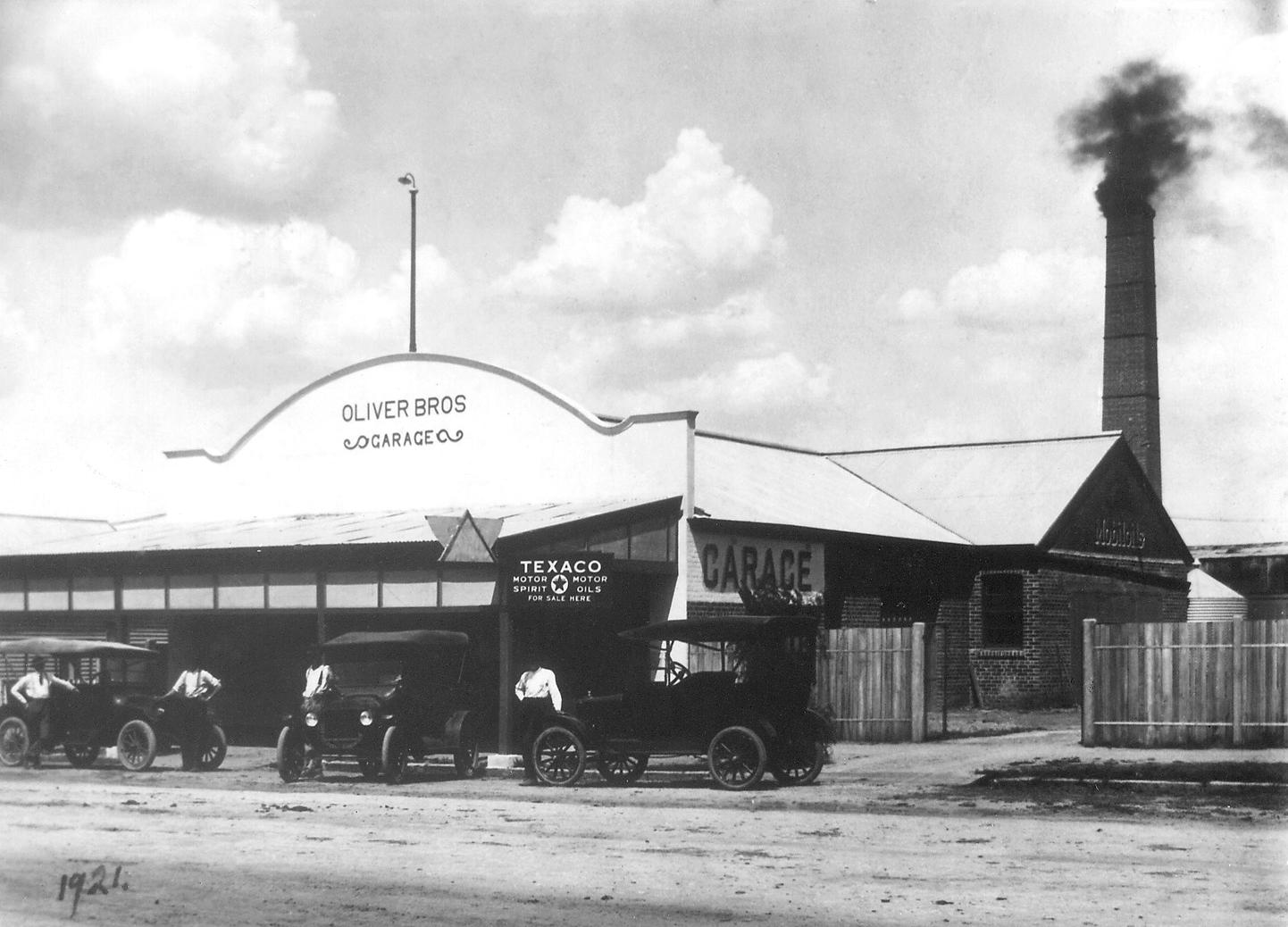
Pike’s Powerhouse pictured from Anzac Hill.
Bill Pike then purchased the property Ruvigne and conducted it for several years before selling out to JR Thomson in 1949, due to ill-health. He retired to Killara, Sydney, with his wife Linda, who was a member of the well-known Cushan family of Gunnedah. Bill Pike died on 6 January 1954, and his funeral was held at Christ Church, Church of England, on 8 January 1954, before interment at the Hunter Street Cemetery. He was survived by his wife Linda, who died in 1969, a brother Miles Pike of Kurri Kurri, and three married sisters who lived in Sydney and Toowoomba.
During his time in Gunnedah, Bill Pike had been involved in many community organisations, serving on the board of Gunnedah Hospital during a period of improvements, with a great deal of voluntary work carried out by him related to the electrical side of the facility.
Bill Pike was captain of the Gunnedah Fire Brigade for many years and a member from its earliest days. He was also a keen member of the School of Arts and a committee man for many years. At the time of his death, he was still a trustee of the institution, where he had spent many happy hours playing billiards. In the sporting field, Bill Pike had been a keen rifleman and a member of the Gunnedah Rifle Club. He served as club captain for many years and even after leaving Gunnedah he had continued to donate an annual prize trophy.
In June 1947, Gunnedah Municipal Council decided to purchase electricity from the bulk supply distributed by the Tamworth City Council.
The local council then began distributing power to district villages and farms, while the Tamworth City Council in 1954 prepared plans, called tenders and began building a power station near the Blackjack coal mine.
Although the large framework was erected, progress ceased on the construction in 1956. Later it was dismantled as the State Grid Electricity Commission (established 1950) absorbed responsibility for all the state electricity production.
From 1 January 1957, the Namoi Valley County Council became the electricity distributing authority throughout this district. Today the electricity distribution network for Gunnedah Shire is operated by Essential Energy with the higher voltage transmission/sub-transition connection into Gunnedah operated by Transgrid, which is separate from the local distributor. In 1948 and 1949, Gunnedah Municipal Council advertised and sold various units from Pike’s Power House. Some building sections were also dismantled, ending the era of a local independent owner-operated electricity supply, while memories of the pioneering Pike family have faded into the mists of time.
To order photos from this page click here